The 2026 Budget brought an eye-catching announcement for entrepreneurs: a new Founders’ Relief, offering a 10% Capital Gains Tax (CGT) rate on up to £10 million of qualifying lifetime gains.
At the same time as introducing this valuable new relief, the Government announced that the lifetime limit for Business Asset Disposal Relief (BADR) will be halved from £1 million to £500,000, while the BADR CGT rate will remain at 18%. Both changes are due to take effect from 6 April 2027.
On the face of it, Founders’ Relief is considerably more generous. The difficulty is that it appears it will also be considerably harder to access.
While BADR is available to a relatively broad range of business owners who satisfy its established conditions, Founders’ Relief is narrowly targeted. Both founders and their companies will need to satisfy a new and potentially demanding set of requirements designed to focus the relief on high-growth, innovative businesses.
The question is therefore not simply how generous Founders’ Relief looks on paper. It is how many founders will actually qualify for it, and how many will instead find themselves on the other side of the equation, being impacted by the cut to the BADR lifetime limit.
Founders’ Relief: who will make the cut?
For now, we do not know exactly what the qualifying conditions will be. They are currently the subject of a technical consultation, which closes on 30 November 2026, with legislation expected to follow in Finance Bill 2026/27.
As currently proposed, the conditions are set out below:
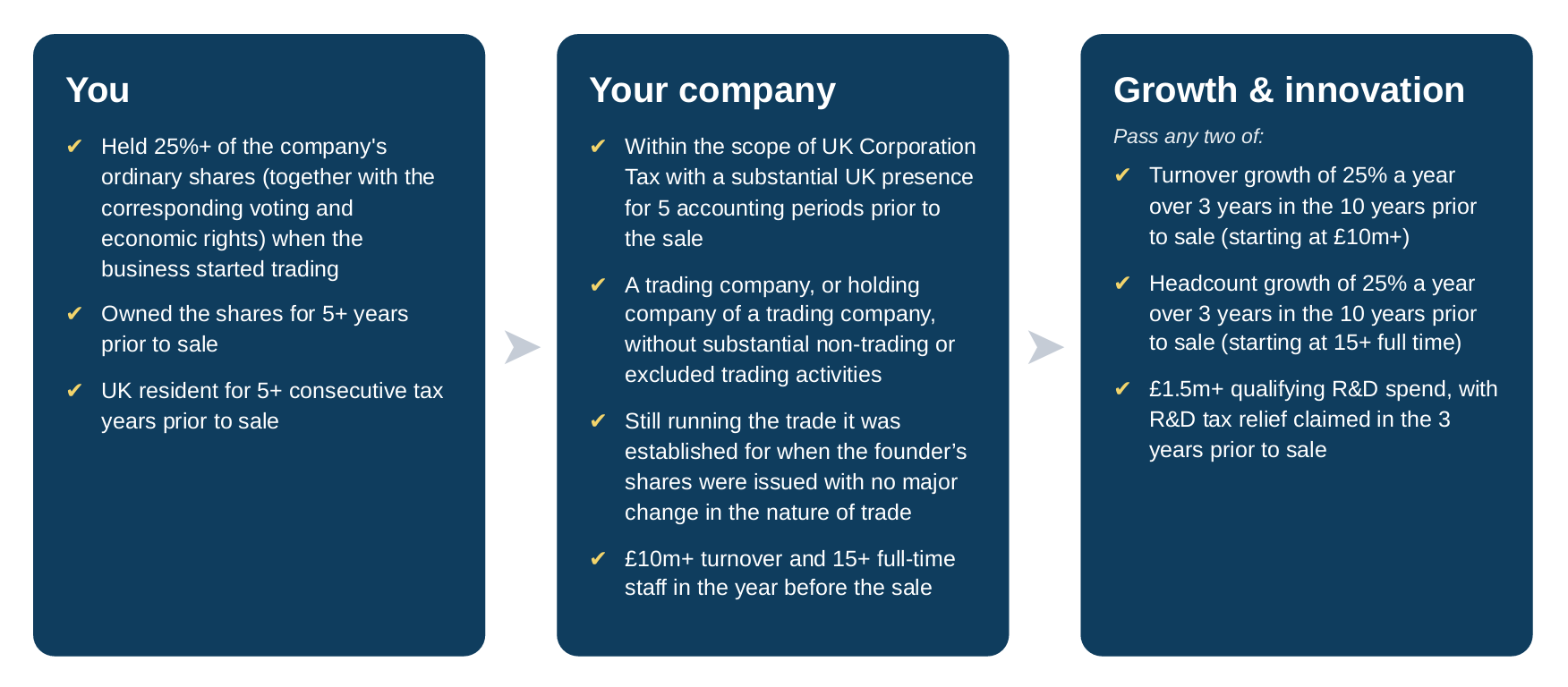
Taken together, those requirements suggest that founding and successfully growing a business will not, by itself, necessarily be enough. The company will need to fit within the particular model of high-growth and innovative business that the Government has chosen to incentivise.
BADR, by contrast, has an established and less extensive set of qualifying conditions. For a typical disposal of shares, an individual must broadly have been an employee or office holder of a trading company, or the holding company of a trading group, for at least two years and, subject to special rules for EMI shares, hold at least 5% of the company's ordinary share capital and voting rights, together with the required 5% economic interest. There are no equivalent turnover, employee growth or R&D thresholds of the kind proposed for Founders’ Relief.
The result is that a founder could have established a successful trading business, created value and ultimately achieved a substantial exit, but still fail to satisfy the conditions for the Government's new more generous relief.
Giving with one hand, taking with the other?
Taken together, the measures suggest a clear shift in the Government’s approach. Instead of providing the same level of CGT relief across a wider population of qualifying business owners, the Government is proposing to concentrate a considerably more valuable incentive on founders and early investors whose businesses satisfy its new growth and innovation criteria.
For those seeking to rely on BADR, the Government has said that three in four claimants will see no change as a result of the reduction. That may be reassuring for those making smaller disposals. However, for business owners expecting to realise more substantial gains, the reduction could still be material.
This creates a potentially significant divide between those able to access the new, more generous relief and the wider population of entrepreneurs and business owners who will instead see the scope of an established relief reduced.
It leaves many questioning how many founders actually fall on the favourable side of that divide.
What happens next?
Much will depend on the final design of Founders’ Relief. The Government's technical consultation is considering the proposed individual, company, growth and innovation conditions, as well as the administrative and compliance requirements for claiming the relief. Until those conditions are finalised, it is difficult to know how wide the pool of qualifying founders will ultimately be.
Founders contemplating a fundraising, reorganisation or exit should keep the proposed rules under review as the legislation develops. In particular, decisions affecting shareholdings, corporate structures and the timing of an exit could become increasingly important.
The Budget may therefore be characterised as giving with one hand while taking with the other: a potentially very valuable new relief for founders who clear the new qualifying hurdles, coupled with a significant reduction in the established relief available to the wider business-owner population. So, while the headline figures for Founders’ Relief are eye-catching, the real question is how accessible the relief will be in practice.